


From EEG Signals to Intelligent Interaction: What Kind of Brain Portal Are Brain-Computer Interfaces Opening?
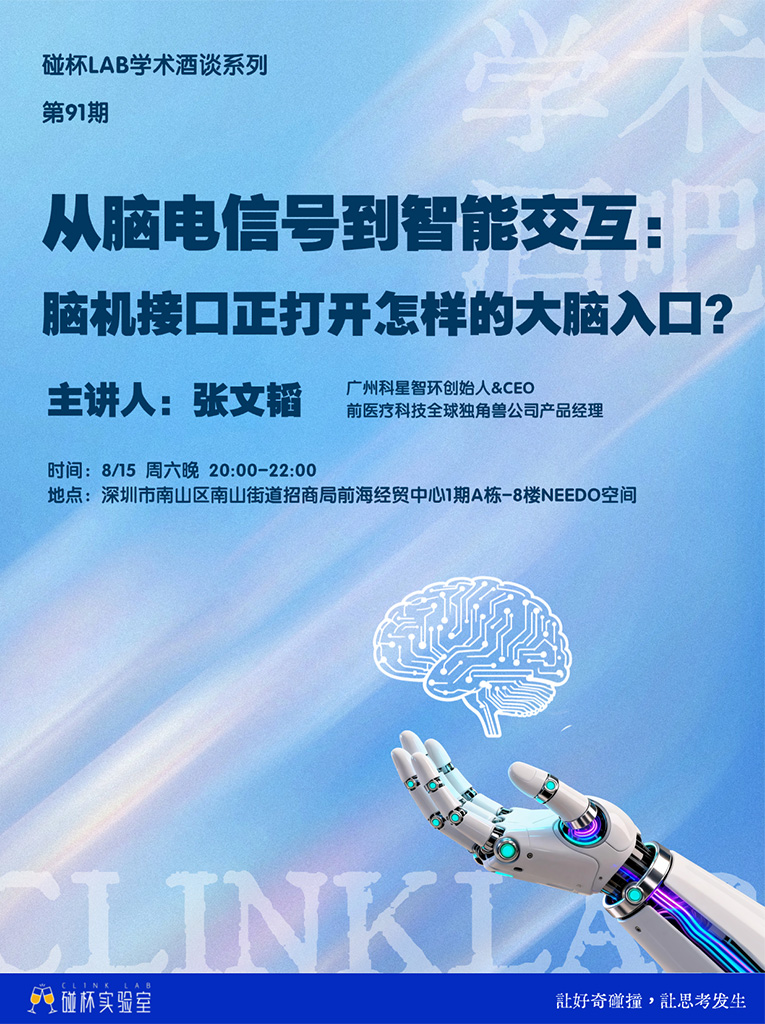
Speaker: Zhang Wentao
Founder & CEO of Guangzhou Kexing Zhihuan
Former Product Manager at a global unicorn company in medical technology
Deeply engaged in brain-computer interface R&D and lightweight implementation; has won multiple sci-tech innovation awards and excels at breaking down hardcore technology and youth entrepreneurship opportunities in accessible terms
The speaker will introduce the research achievements of the collaborative team in this field
Team Researcher: Niu Xu
Assistant Professor at the Frontier Institute of Science and Technology, Xi'an Jiaotong University
Serial entrepreneur, Co-founder & CTO of Kexing Zhihuan
First author of six SCI papers on EEG algorithms, including four in top journals
Former President of the Technology Transfer Association of Xi'an Jiaotong University; Former President of Ruide Wenyuan, Xi'an Jiaotong University
Content Introduction:
From Descartes' philosophical inquiry "I think, therefore I am" to contemporary neuroscience's layer-by-layer decoding of the brain's working mechanisms, humanity has never ceased exploring the ultimate question of "how consciousness arises." The emergence of Brain-Computer Interface (BCI) technology has given us, for the first time, the possibility of directly "reading" brain intentions and even "writing" neural information — the brain is no longer an untouchable black box, but is becoming an interactive intelligent interface.
In recent years, with the convergence of neural engineering, artificial intelligence, and microelectronics, brain-computer interfaces are accelerating from sci-fi concepts to real-world applications. From helping paralyzed patients rebuild motor function to enabling direct dialogue between the human brain and external devices, this technology is redefining the boundaries of human-machine interaction. However, from laboratory prototypes to clinical implementation, from invasive implants to non-invasive wearables, brain-computer interfaces still face multiple challenges including signal acquisition, decoding algorithms, and long-term stability.
This session will approach the topic from multiple perspectives, including the technical classification of brain-computer interfaces, signal processing, and intelligent interaction, to understand how BCIs can serve as a bridge connecting the brain and the digital world, and how non-invasive EEG technology, empowered by AI, can break through the bottlenecks of signal processing and move toward broader application scenarios.
We will explore together:
1. The classification system of brain-computer interface technology — invasive, semi-invasive, and non-invasive — as well as the relationships among the three types and their respective characteristics and limitations in practical applications.
2. Current successful application cases of brain-computer interfaces, along with the classification, acquisition standards, and signal characteristics of non-invasive EEG brain signals.
3. The key points and difficulties in EEG brain signal processing, and how AI adaptive filtering technology can break through the bottlenecks of signal denoising and feature extraction — sharing the latest research findings of the team's Assistant Professor Niu Xu in this field.
Target Audience:
1. Those interested in the interdisciplinary fields of brain science, neural engineering, and artificial intelligence;
2. Those who wish to understand the current status, application scenarios, and future trends of brain-computer interface technology;
3. Researchers and practitioners focused on neural signal processing, biomedical engineering, and intelligent interaction technology;
4. Professionals in the technology, healthcare, investment, and education sectors.